
Free shipping on qualifying US orders Thoughtfully selected for happier pets
Follow Us! ig f p x yt
Atloras Pet Journal

How to Keep Your Cat Happy Indoors

Happier Cat

Keeping a cat indoors can provide a safe and comfortable life—but indoor cats still need opportunities to play, explore, climb, scratch, hunt, rest, and interact.

A home doesn’t have to be huge or complicated to become an enriching environment for your cat. With a few thoughtful changes and consistent daily habits, you can create a space where your feline companion feels safe, stimulated, comfortable, and loved.

In this guide, we’ll explore 10 practical ways to keep an indoor cat happy, from creating safe spaces and providing interactive play to improving mealtimes, grooming, scratching, and everyday enrichment.


Why Indoor Enrichment Matters

Indoor living protects cats from many outdoor hazards, including traffic, predators, parasites, and potentially dangerous encounters with other animals. But a safe home environment still needs to satisfy a cat’s natural behaviors.

Cats naturally want to stalk, chase, scratch, climb, hide, explore, observe, and rest.

Without enough opportunities to perform these behaviors, an indoor environment can become predictable and boring.

Veterinary behavior guidance recommends giving indoor cats opportunities for physical activity, mental stimulation, social interaction, hunting-style play, scratching, climbing, and elevated resting places.

The goal isn’t to turn your home into a playground.

It’s to make everyday life more interesting.


10 Ways to Keep Your Indoor Cat Happy

1. Create a Safe and Comfortable Home Base

Every cat should have somewhere they can retreat when they want peace and quiet.

This could be:

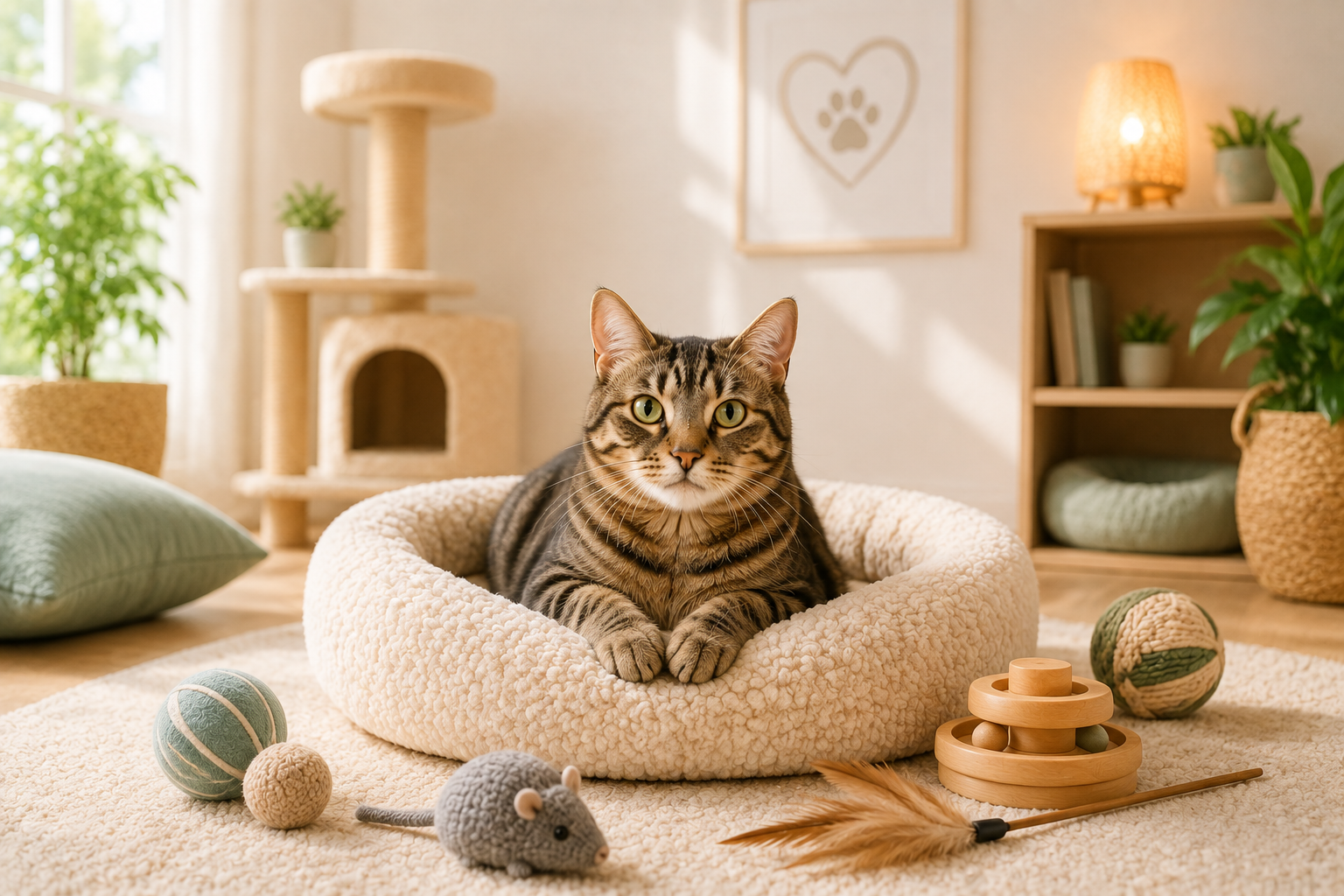
  • A cozy cat bed
  • A covered cat house
  • A cardboard box
  • A quiet corner
  • A cat tree
  • A comfortable elevated perch

Some cats prefer enclosed spaces, while others feel more comfortable watching the household from above.

Veterinary environmental guidelines recommend providing cats with safe places where they can retreat, with elevated options being particularly useful for many cats.

The important part?

Let your cat choose when they want to use the space.

A safe area should feel like a retreat—not a place where your cat is forced to stay.


2. Give Your Cat Opportunities to Climb

Have you ever noticed your cat sitting on the highest piece of furniture in the room?

There’s a reason.

Many cats naturally enjoy elevated resting locations because they allow them to observe their surroundings while feeling secure.

A cat tree, window perch, sturdy shelf, or other safe elevated area can give your cat another dimension of space to explore.

Cat trees can also combine:

Climbing + scratching + hiding + resting + play

That’s particularly valuable for indoor cats because one piece of enrichment can satisfy several natural behaviors.

Always make sure elevated furniture is stable and safe before allowing your cat to use it.


3. Make Playtime Part of Every Day

Play isn’t just entertainment.

Interactive play gives cats an opportunity to express natural hunting behaviors such as stalking, chasing, pouncing, and catching.

Try using:

  • Wand toys
  • Feather toys
  • Toy mice
  • Balls
  • Interactive toys
  • Chase toys
  • Food puzzles

Rather than leaving every toy available all the time, rotate them.

A toy that disappears for several days can feel interesting again when it returns.

Veterinary behavior specialists recommend several short play sessions throughout the day for many cats, especially when play mimics prey movement.

A simple idea

Instead of one long play session, try:

Morning: 5–10 minutes
Afternoon: short enrichment activity
Evening: 10–15 minutes of interactive play

Your cat’s age, health, personality, and preferences should determine the appropriate routine.


4. Encourage Your Cat’s Natural Hunting Instinct

Even a well-fed indoor cat can have a strong desire to stalk and chase.

That’s because hunting behavior isn’t simply about hunger.

You can provide a safe outlet by turning playtime into a miniature hunting game.

Move a wand toy slowly.

Let your cat watch.

Make it dart away.

Allow your cat to chase.

Then give them an opportunity to catch it.

This kind of play can be much more engaging than simply leaving a toy on the floor.

Important safety tip

Never leave string, ribbon, or similar toys unattended with your cat because they can potentially be swallowed.

Put interactive toys away after supervised play.


5. Turn Mealtime Into Enrichment

Mealtime doesn’t always have to mean putting food into a bowl and walking away.

Food-based enrichment can encourage cats to forage, explore, and work for part of their food.

Consider:

  • Puzzle feeders
  • Slow feeders
  • Treat-dispensing toys
  • Hiding small portions around safe areas
  • Interactive feeding activities

Veterinary guidance notes that food puzzles and foraging activities can provide both mental stimulation and physical activity for indoor cats.

However, keep track of your cat’s total daily food intake.

Treats and enrichment food should be accounted for as part of the overall diet rather than simply added on top.


6. Give Your Cat a Good Scratching Area

Scratching is normal cat behavior.

It isn’t something you should try to eliminate.

Cats scratch for several reasons, including claw maintenance, stretching, visual marking, and scent communication.

Instead of trying to stop scratching, give your cat appropriate places to do it.

Try different options such as:

  • Vertical scratching posts
  • Horizontal scratchers
  • Cardboard scratchers
  • Sisal scratching posts
  • Scratching boards

Place scratching areas where your cat actually spends time.

If you hide the scratching post in an unused room, your cat may simply choose the sofa instead.


7. Provide Interesting Views

Windows can become natural entertainment centers for indoor cats.

A safe window perch can give your cat an opportunity to watch:

  • Birds
  • People
  • Trees
  • Weather
  • Neighborhood activity
  • Outdoor movement

A comfortable elevated resting area near a window can provide both relaxation and mental stimulation.

Just make sure windows and screens are secure.

Your cat should be able to enjoy the view without being exposed to unsafe falls or escapes.


8. Give Your Cat Plenty of Positive Attention

Cats have individual personalities.

Some love sitting on your lap.

Others prefer sitting beside you.

Some enjoy being brushed.

Others prefer a short play session.

The key is to respect your cat’s preferences.

Positive, predictable human interaction is one of the important elements of a cat-friendly environment. Veterinary environmental guidelines recommend allowing cats to participate in social interaction in ways that suit their individual preferences rather than forcing interaction.

You can strengthen your bond through:

  • Gentle petting
  • Play
  • Brushing
  • Talking
  • Positive-reinforcement training
  • Quiet time together

Sometimes simply sitting in the same room is enough.


9. Keep Grooming and Everyday Care Consistent

Regular grooming can be a valuable part of your cat’s routine.

Depending on your cat’s coat and individual needs, this may include:

  • Brushing
  • Nail care
  • Coat checks
  • Dental care
  • Ear checks
  • Regular litter-box maintenance

Grooming is also an opportunity to notice changes that may otherwise go unnoticed.

If you notice unusual lumps, skin changes, persistent bad breath, changes in appetite, unusual behavior, or other concerns, contact your veterinarian.


10. Keep Your Cat’s Routine Predictable

Cats often appreciate consistency.

Try to maintain reasonably predictable patterns for:

  • Feeding
  • Play
  • Rest
  • Grooming
  • Litter-box care
  • Social interaction

A routine doesn’t have to be rigid.

Your cat simply benefits from knowing that important resources and activities are reliably available.

When major changes happen—such as moving homes, introducing another pet, or changing schedules—try to preserve familiar beds, toys, scratching areas, and routines where possible.


🐾 Don’t Forget the Litter Box

A clean and appropriately located litter box is one of the most important everyday resources for an indoor cat.

Keep the litter area clean and easy to access.

In multi-cat homes, providing sufficient, separated resources can help reduce competition and stress. Veterinary environmental guidelines recommend separating important resources such as food, water, toileting, resting, scratching, and play areas rather than putting everything in one location.

If your cat suddenly stops using the litter box or develops unusual toileting behavior, don’t simply assume it’s a behavioral problem.

A veterinary evaluation may be appropriate.


🏠 How to Create an Indoor Cat Enrichment Zone

You don’t need to buy dozens of products.

Start with one area of your home and create a small enrichment zone.

Your setup could include:

A comfortable bed
For sleeping and relaxing.

A scratching post
For scratching and stretching.

A cat tree or perch
For climbing and observing.

Interactive toys
For play and hunting-style activity.

A puzzle feeder
For mental stimulation.

A quiet hiding place
For privacy.

A nearby window
For safe visual enrichment.

Then rotate toys and activities so the environment doesn’t become predictable.


🐱 A Simple Daily Routine for an Indoor Cat

Here’s an example routine you can adapt to your cat:

Morning

Fresh water

Breakfast

Short interactive play

Quiet rest

Afternoon

Puzzle feeder or enrichment activity

Window/perch time

Nap

Evening

Interactive play

Dinner

Grooming or gentle attention

Quiet family time

Before Bed

Fresh water

Litter-box check

Short play session

Comfortable sleeping area

Remember: there is no universal schedule that works for every cat.

Age, health, personality, household environment, and activity level all matter.


Signs Your Indoor Cat May Need More Enrichment

Every cat is different, but changes in behavior can sometimes indicate boredom, stress, or an unmet need.

Watch for things such as:

  • Persistent destructive behavior
  • Excessive attention-seeking
  • Reduced interest in normal activities
  • Significant changes in grooming
  • Unusual hiding
  • Changes in appetite
  • Changes in litter-box behavior
  • Increased conflict with other pets
  • Repetitive behaviors

These signs don’t automatically mean your cat needs more toys.

Behavior changes can have medical or emotional causes, so persistent or concerning changes should be discussed with your veterinarian.


How Many Toys Does an Indoor Cat Need?

There isn’t a magic number.

Variety is generally more important than quantity.

You might have:

  • 2–3 interactive toys
  • 1–2 scratching options
  • A few simple toys
  • A puzzle feeder
  • A cat tree or climbing area
  • A comfortable bed
  • A hiding space

Rotate toys periodically instead of leaving everything out at once.

Your cat may become more interested in an old toy when it reappears after a break.


Can an Indoor Cat Really Be Happy?

Absolutely.

Indoor cats can live rich and rewarding lives when their environment allows them to express natural behaviors.

The key is not simply keeping your cat inside.

It’s creating an indoor environment where your cat can:

Climb.

Scratch.

Play.

Explore.

Hunt.

Rest.

Hide.

Observe.

Interact.

Feel safe.

That’s what transforms a house into a cat-friendly home.


Final Thoughts

A happy indoor cat doesn’t need a perfect home.

They need a home that understands what cats naturally enjoy.

Give them safe places to retreat, opportunities to climb and scratch, daily interactive play, interesting ways to explore food, comfortable resting areas, positive attention, and consistent everyday care.

Most importantly, get to know your individual cat.

What makes one cat excited might make another cat nervous. Watch their body language, respect their boundaries, and gradually introduce new experiences.

At Atloras, we believe that better pet care isn’t about complicated routines.

It’s about the little things we do every day.

A safe home.
A good meal.
A fun game.
A cozy nap.
A little attention.
A lot of love.

Because Better Everyday Life for Pets starts with understanding what they need to feel happy at home. 🐾


Frequently Asked Questions

How can I keep my indoor cat happy?

Provide a safe environment with daily play, mental enrichment, scratching opportunities, elevated resting places, comfortable sleeping areas, appropriate nutrition, clean water, positive social interaction, and regular veterinary care.

Do indoor cats need daily play?

Yes. Indoor cats benefit from regular opportunities for physical activity and mental stimulation. Several short interactive play sessions can be a practical approach for many cats.

Are cat trees good for indoor cats?

Cat trees can provide climbing, elevated resting, hiding, scratching, and play opportunities, making them particularly useful enrichment for many indoor cats.

How do I mentally stimulate my indoor cat?

Try puzzle feeders, food-based enrichment, interactive toys, hunting-style games, new safe objects, climbing areas, window views, and short training sessions.

Should I let my cat choose when to interact with me?

Generally, yes. Cats have different social preferences. Positive, predictable interaction works best when you respect your cat’s signals and avoid forcing interaction.

Is it safe to leave string toys with my cat?

No. Toys containing strings, ribbons, or similar parts should be used under supervision and put away afterward because they can potentially be swallowed.